OHLC prices and candle colour
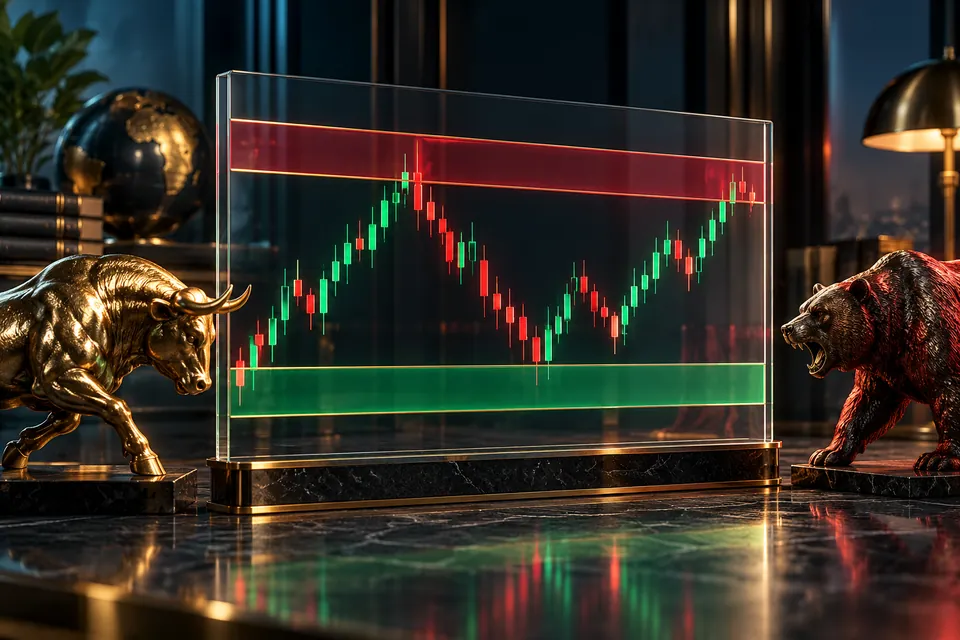
Open is the first price of the interval, High the maximum, Low the minimum and Close the final price. The body spans open to close, while wicks extend to the extremes. In a typical setup a green body closes above the open and a red one below it. Platforms may use different colours.
The timeframe defines the interval: an M15 candle represents fifteen minutes and H1 represents an hour. Before comparing charts, check the timeframe, time zone and data source. Session boundaries and different quotes can produce slightly different candles, particularly around the start and end of a trading day.
How to identify a doji on a forex chart
A doji has an open and close close together, so its body is small. Its upper and lower wicks need not be equal. It shows that the interval ended near where it began, even if price covered a wide range in between. It does not automatically mean a trend reversal.
Inside a quiet range, a doji can simply be ordinary back-and-forth movement. After a strong move near a relevant area, it may prompt a question about weakening momentum. That is a question for analysis rather than a ready-made order. Evaluate the next close according to rules chosen in advance.
Related guide: Forex support and resistance: how to draw useful zones
Hammers and shooting stars need the right location
A hammer has a small body near the upper part of the candle range and a long lower wick. A reversal interpretation looks for it after a decline. A shooting star has a small body lower in its range and a long upper wick; its reversal context involves a preceding rise.
A similar shape elsewhere can have a different meaning. Do not label every long wick as an entry signal. Examine the previous candles, the total range and the distance to relevant levels. A pattern name cannot replace a condition that tells you when the trading idea is no longer valid.
One candle shape in two different settings
Imagine a candle with open 100, close 101, low 96 and high 101.5. Its lower wick is longer than its body. After a decline near a previously marked area, it raises a different question from the same candle in the middle of a disorderly range. The prices are illustrative.
Why candle location changes the interpretation
The first setting might support testing a defined rebound-confirmation rule; the second may offer no useful location and be skipped. Neither guarantees a rise. Record the evaluation rule before revealing the next candles, so the eventual result cannot quietly rewrite your explanation of the initial setup.
Practise recognising shapes without guessing the future
In Trader Games, match a name to the highlighted candle. Describe the body and both wicks before choosing a label. Distinguish one candle from a multi-candle pattern. In the Market Trainer, compare the same shape across different historical segments of your chosen market.
Evaluate closed candles: a candle still forming can change its body and wicks. After practice, note which settings made the observation useful and which made it ambiguous. This builds a consistent reading process. Memorising names without their setting makes it easy to see signals in almost every small fluctuation.
Related guide: Forex replay and backtesting: practise on historical charts
Questions and answers
Is a green candle a buy signal?
No. Its colour typically describes close relative to open for one interval. It is not a standalone trading instruction.
Does every doji predict a reversal?
No. Doji candles can appear in ranges and during continuation. Their interpretation needs context and a defined evaluation rule.
What is the difference between a doji and a hammer candle?
A doji has open and close prices very near each other. A hammer has a small body near the top of its range and a long lower wick; its reversal interpretation depends on a preceding decline. Describe both proportions and context first. The shape alone is insufficient for a trading decision.
Practise in the app
App tools may require sign-in. Articles can be read without an account.Sources and further reading
This guide contains original educational examples, not current trading recommendations. The links below provide further reading and do not imply a partnership with their publishers.
Sources checked: 17 October 2026